

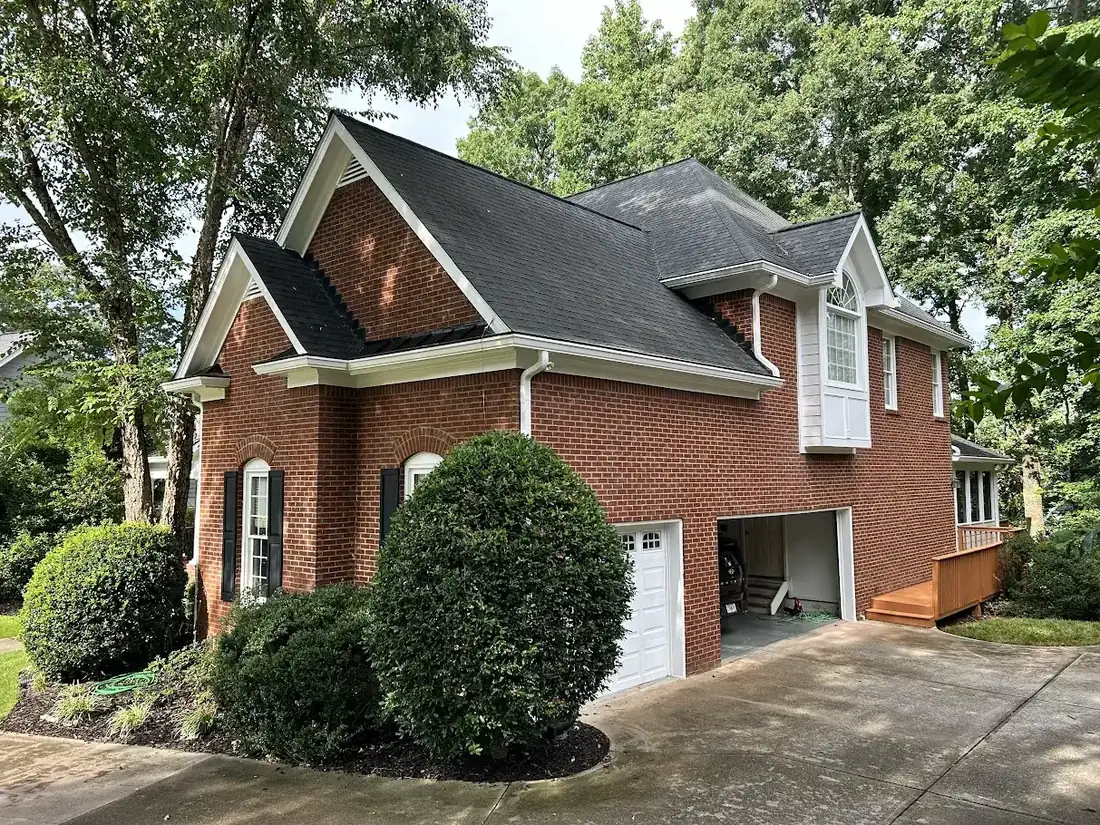
When is the best time of year to paint a house exterior in metro Atlanta?
For most houses around the city, the reliable windows are mid-spring and fall. Late April and May give warm days, cooler nights and fewer afternoon storms than July. September and October do the same from the other side of summer, with lower humidity and a forecast you can trust for a few days at a time.
We still paint in June when the week is dry and the wall sits in the shade while the coat goes on. On a hot week the crew starts earlier and moves off a west wall before the surface bakes the film. The next stretch of weather on that elevation matters more than the name of the month.
Pollen moves the spring date more than the thermometer does. Pine and oak pollen coats siding, brick and trim in early spring across Roswell, Marietta, Johns Creek and the rest of the north metro. Paint will not stick to that yellow film. We wash the house after the dust has dropped, then coat it, and we do the same for the red clay splash that rains leave along the foundation.
Can you paint a house in an Atlanta winter, and what is the lowest safe temperature?
Yes, on the right day. Atlanta winters are mild enough that a clear afternoon is a real painting day, as long as the night stays above the minimum printed on the paint can.
For the Sherwin-Williams and Benjamin Moore exterior acrylics we use on houses, we follow the temperature on the can for both the air and the surface, and we hold that through the cure. If the overnight low is headed under the label minimum, the crew waits.
A film that gets cold before it forms stays soft, and it fails early. A winter day that only warms up for a short stretch in the afternoon is usually too short a window. The siding has to be warm enough while the coat is still forming, not only at the moment the brush hits the board.
We check the wall with a surface thermometer, because brick and shaded trim lag the air on a cold morning. A mild reading at the airport does not mean a shaded brick wall is warm enough to coat.
Is it okay to paint the exterior in October, or is it already too cold?
October is one of the better months on our schedule. Highs in metro Atlanta are usually mild, nights are cool and usually stay above the minimum on the can, and the daily thunderstorm pattern of July has eased. Early November still works on many houses. By late November and December the good days sit between cold fronts, so those weeks need room in the schedule to pause.
If a cold front is going to drop the night under the minimum on the can before the finish coat has cured, we stop before that coat goes on. A coat that already cured on a warm day handles the cold that follows. The coat that is still soft is the one a freeze hurts.
How do Atlanta humidity, dew and summer heat change the calendar?
Humidity is the other half of the temperature rule. Latex needs the water to leave the film, and when the air is saturated that happens slowly. A coat can stay tacky overnight, then pick up dust and pollen before it hardens.
We want the surface above the dew point so moisture is not condensing on the wall while the paint forms. A wall that has already cooled to the dew point waits, even when the day feels fine to stand outside. That same check keeps a spring morning from getting a coat while the siding is still sweating.
Summer in metro Atlanta fails that check more often. Afternoons get hot, and the air often stays muggy into the evening. A west or south wall in full sun runs much hotter than the air.
Paint that skins over on a hot surface wrinkles and loses its grip. We paint those elevations in the morning, or we move to a shaded side and come back later in the day. Shaded north walls have the opposite problem. Under oaks and pines they stay damp, which is where mildew shows up first.
We do not coat a wall that is still wet from morning dew, and we stop early enough that the film has skinned before the dew comes back. What humidity does to a coat after the job, including mildew on shaded walls, is in our guide to Atlanta humidity and exterior paint.
What happens if it rains on fresh exterior paint, and how long does it need to dry first?
The wall has to be dry before the coat goes on, and the forecast has to stay dry after it. We follow the dry time on the can before rain, and we still want the rest of that day clear, because a storm over Atlanta is rarely a light sprinkle.
A hard rain before the film has skinned can streak or wash it. Once the coat has cured through a dry night, a normal rain does not lift it. If rain sits inside that window, the crew washes, caulks or paints a covered elevation instead of forcing the finish coat.
Brick and fresh caulk joints hold damp from the night before, long after the siding looks dry. We check those joints before the first coat. The same sequence, wash then dry then coat, is how our exterior painting crews run a house that started with a wash the day before.
Does the window change in Roswell, Marietta, Johns Creek or Peachtree City, or is it the same metro climate?
The calendar is the same metro climate. Roswell, Marietta, Johns Creek and Peachtree City share the humidity, the pollen pulse and the summer heat. A house on a ridge in full west sun runs hotter than one under mature trees, and a shaded north wall stays damp longer. We do not keep a separate season for each city.
What changes is the house. Wood siding with failed caulk, chalking paint and bare boards needs more prep days than sound cement board. Caulk and primer have their own temperature floors, so a cold night can stop the prep even when the days we booked looked clear. The wash, the repairs and the coats stay on one schedule so that night does not land on an open coat.
If you are lining the season up against the size of the job, the painting cost page is where we spell out what changes the scope. The forecast picks the week. Interior work is the part we can keep moving when the exterior is on hold, and that work is on our interior painting page.
The Roswell and Marietta offices book this same calendar. Call (770) 551-0101 or request a free quote and we will look at the house and the next dry stretch before we set a start date.